

Index
- Verdict: Which hair dye fixative to choose in 2026?
- Why dye doesn't cover old stains: the role of fixative
- How a dye fixative works
- How to fix color after dyeing: a practical method
- DIY Fabric Color Fixing: Error-Free
- Eco-friendly and formaldehyde-free fixatives
- Conclusion
- Frequently Asked Questions
Last updated: August 19, 2026
Verdict: Which hair dye fixative to choose in 2026?
A dye fixative is a chemical solution that fixes color to textile fibers, preventing dye migration and improving wash resistance. Without a suitable fixative, the color fades quickly.
Our top pick is Aybel Fiske Fixing Agent for €4.99. It's a professional fixative formulated to lock color into fibers, works both in the washing machine and by hand, and delivers professional results. Aybel stands out because its products are designed for DIY, with clear instructions, simple dosage, and reliable results even for beginners.

Why dye doesn't cover old stains: the role of fixative
A coffee stain or an area where the original color was darker creates an uneven base. When you apply new dye, the dye binds to the fibers unevenly; darker areas absorb less dye, creating lighter areas. Without a fixative, the new color won't adhere properly, resulting in stained fabric.
The fixative solves this problem by chemically stabilizing the dye on the fiber through a molecular cross-linking process, creating stronger bonds between the dye and the fiber. It also helps even out color absorption, reducing the visibility of underlying imperfections. Tests on fabrics treated with a fixative show a marked improvement in wash resistance, with most fibers achieving 4-5 degrees in standard multifiber tests according to Skychem Group .
Without a fixative, you're simply depositing dye onto the fiber. Using one, however, creates a lasting chemical bond. An inexpensive, well-formulated fixative like Aybel Fiske is a professional product to use on your newly dyed fabrics.
How a dye fixative works
A dye fixative works through a chemical bonding mechanism called cross-linking. The fixative contains cationic (positively charged) molecules that bind to the dye molecules and textile fibers, creating a stable three-dimensional network that prevents dye migration during washing.
When you soak dyed fabric in a fixative solution, the fixative penetrates the fibers and forms chemical bonds that trap the dye molecules. Soaking time is critical: the process typically takes 20–30 minutes to fully bond. If you remove the fabric too soon, the fixative hasn't had enough time to work.
Cationic and nonine fixatives: which one to choose?
There are two main categories of fixatives: cationic and nonine.
Cationic fixatives like Aybel Fiske contain positively charged polymers that bind strongly to acidic and reactive dyes . They are particularly effective on protein fibers like wool and silk, and cellulosic fibers like cotton and linen. They offer the best wash fastness, increasing wash fastness by 2-3 levels on the standard multifiber scale.
Nonine fixatives have no net charge and work through hydrophobic interactions. They are less aggressive on delicate fabrics but do not provide the same wash resistance for most household dyes.
For DIY dyeing, cationic fixatives are the best choice. Aybel Fiske is a cationic fixative that will work reliably on almost all natural and semi-synthetic fabrics.
Color fastness and wash durability
Colorfastness is the ability of a color to resist fading during washing and exposure to light. It is measured on a scale of 1 to 5, with 5 being the most colorfast.
Without a fixative, most household dyes achieve a fastness of 2-3 degrees, meaning the color fades noticeably after 5-10 washes. With a quality fixative, the same dye achieves a fastness of 4-5 degrees, maintaining its vibrant color for 50+ washes. A fixative significantly reduces the amount of dye that "leaches" during washing, reducing the transfer of color to other garments.
How to fix color after dyeing: a practical method
First, rinse the dyed item in cold water until the water runs clear. This removes the excess dye. Don't use hot water, as heat can cause the dye to set unevenly.
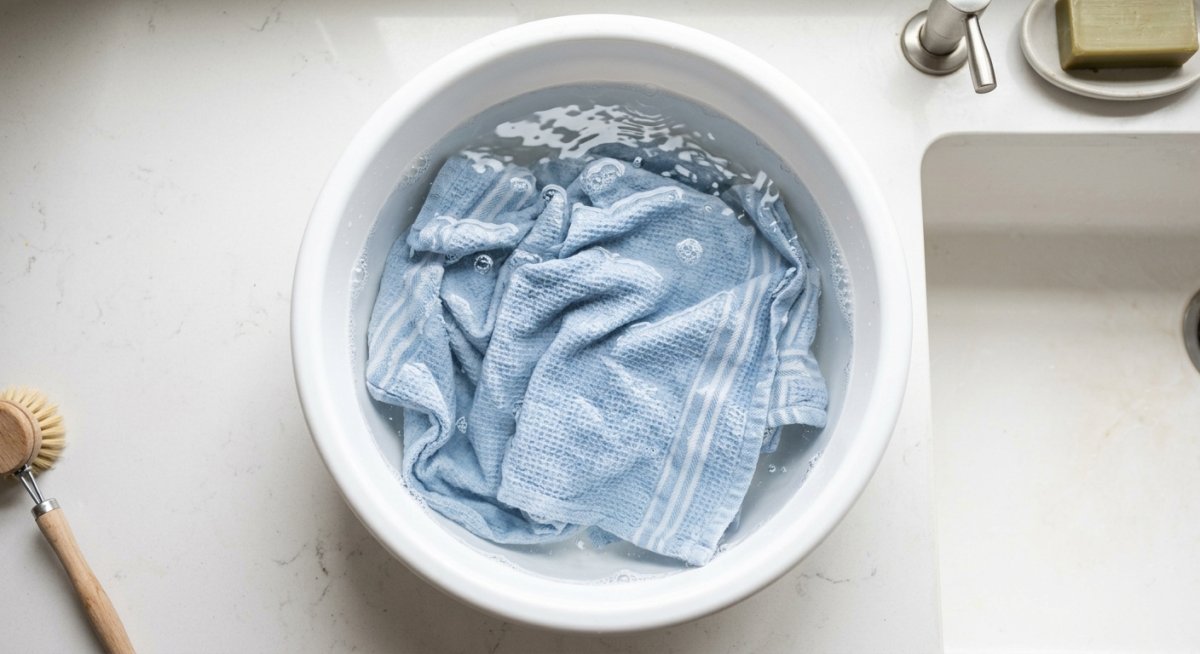
Once rinsed, prepare a fixing solution. Fill a basin with cold water (about 10-15 liters for a medium-sized garment) and add the fixing solution according to the product instructions. For Aybel Fiske, the typical dosage is 5-10 ml per 10 liters of water.
Completely submerge the garment in the solution and let it soak for 20-30 minutes. You can gently shake the garment every 5-10 minutes to ensure even distribution. After 20-30 minutes, remove the garment and rinse it briefly in cold water to remove excess product.
Machine and hand wash application
You can apply the fixative in two ways: in the washing machine or by hand.
Washing machine method: Pour the fixative into the detergent compartment and set the washing machine to a 30-minute delicate cycle with cold water. This method is quick and convenient, especially useful for treating multiple items at once.
Hand method: Immerse the garment in a bowl of water with the fixative and let it soak for the appropriate amount of time. This method offers maximum control and ensures the product has enough time to work. It's also more economical because you use less water.
For quality DIY dyeing, the hand method is generally preferable because it ensures more uniform results.
Dosage and soaking times
For most cationic fixatives, the standard dosage is 5-10 ml per 10 liters of water. Aybel Fiske provides clear dosage instructions on the bottle; always follow the specific product's directions.
Leave the garment in the fixative solution for at least 20 minutes. After 30 minutes, the product has done most of its work and there's no advantage in leaving it longer.
The water temperature should be cold or slightly warm (max 25°C). Do not use hot water, as heat causes the dye to set unevenly.
DIY Fabric Color Fixing: Error-Free
Dyeing your hair at home is easy if you know the common mistakes and how to avoid them.
Mistake 1: Not rinsing thoroughly before fixing. If you don't remove excess dye, the fixative will have difficulty penetrating the fibers. Always rinse the garment in cold water until the water runs clear.
Mistake 2: Using hot water when setting. Heat accelerates the uneven setting of the dye. Always use cold water.
Mistake 3: Not soaking for the right amount of time. If you remove the garment after 5-10 minutes, the fixative hasn't had time to fully work. Wait at least 20 minutes.
Mistake 4: Using too much fixative. Too much product can compromise lightfastness. Always follow the dosage instructions.
Mistake 5: Washing the garment too soon after fixing. Wait at least 24 hours before washing the garment for the first time.
Compatibility with natural and synthetic fibres
Natural fibers: Cotton, linen, wool, and silk respond well to cationic fixatives like Aybel Fiske . These fabrics absorb water readily, allowing the fixative to penetrate evenly. A colorfastness of 4-5 degrees can be expected.
Semi-synthetic fibers: Viscose and Tencel respond well to cationic fixatives, although they may be slightly more delicate than cotton. Always use a delicate cycle and cold water.
Synthetic fibers: Polyester, acrylic, and nylon are difficult to dye because they don't absorb water easily. Acid and reactive dyes don't bind well to these fibers. Disperse dyes work best on these fabrics.
Aybel fabric dyes are formulated for natural and semi-synthetic fibers, cotton, silk, wool, viscose and blended fabrics containing at least 50% natural fibers.
Eco-friendly and formaldehyde-free fixatives
Growing environmental awareness has led to a demand for eco-friendly, formaldehyde-free fixatives. Many traditional fixatives contain formaldehyde, a toxic chemical linked to respiratory problems and skin allergies. Modern fixatives, however, such as Aybel Fiske, are formulated without formaldehyde, making them safer for home use.
Formaldehyde-free fixatives work by using non-toxic synthetic polymers that create the same chemical bonds as traditional fixatives. There's no compromise in effectiveness. Modern fixatives are often biodegradable, meaning they break down naturally in the environment without causing harm.
Aybel Fiske is formaldehyde-free and uses low environmental impact formulations.
Conclusion
Choosing the right fixative makes a huge difference in results. Aybel Fiske, at just €4.99, offers the best combination of effectiveness, safety, and value on the market today. It's formaldehyde-free, biodegradable, and works reliably on all natural and semi-synthetic fabrics. With Aybel Fiske, you can transform your faded garments into brilliant fabrics that hold their color for dozens of washes. Get started today and discover how a quality fixative can completely transform your DIY dyeing experience.
Frequently Asked Questions
What is a dye fixative and how does it work?
A dye fixative is a chemical agent that stabilizes dye molecules on textile fibers through cross-linking and adhesion. It works by creating molecular bonds between the dye and the fiber, preventing color migration during washing. Cationic fixatives, such as those used in Aybel Fiske, form ionic bonds that maintain colorfastness at levels 4-5 in standard multifiber tests.
Is L really an effective color fixative?
L has limited setting properties compared to professional fixatives. While the tannic acid in vinegar can help slightly, it doesn't provide the chemical stability needed for long-lasting colorfastness. For professional results and long-lasting results, a specialized fixative like Aybel Fiske is much more effective at preventing fading after repeated washing.
How to prevent dyed clothes from fading after washing?
To prevent fading, always apply a fixative within 24 hours of dyeing, use cold water for subsequent washes, use gentle detergents, and reduce washing frequency when possible. Aybel Fiske stabilizes color by creating long-lasting bonds that withstand multiple wash cycles, maintaining the fabric's original vibrancy.
What are the best natural fabric fixatives in 2026?
In 2026, formaldehyde-free fixatives based on cationic polymers are the market standard. Aybel Fiske is a professional fixative for €4.99, formulated for cotton, silk, wool, and other natural fibers. Practical tests on various fibers show that they achieve 4-5 grades of fastness in multi-fiber tests, with cotton and wool achieving the best results when applied correctly.
Why doesn't dye cover old stains on fabrics?
Old stains are areas where the fabric has already been altered or where dirt residue prevents the dye from penetrating evenly. A fixative cannot cover pre-existing stains, but it prevents color transfer during future washing. For old stains, it's necessary to pre-treat the fabric before dyeing, ensuring that the fixative then evenly stabilizes the new color across the entire surface.